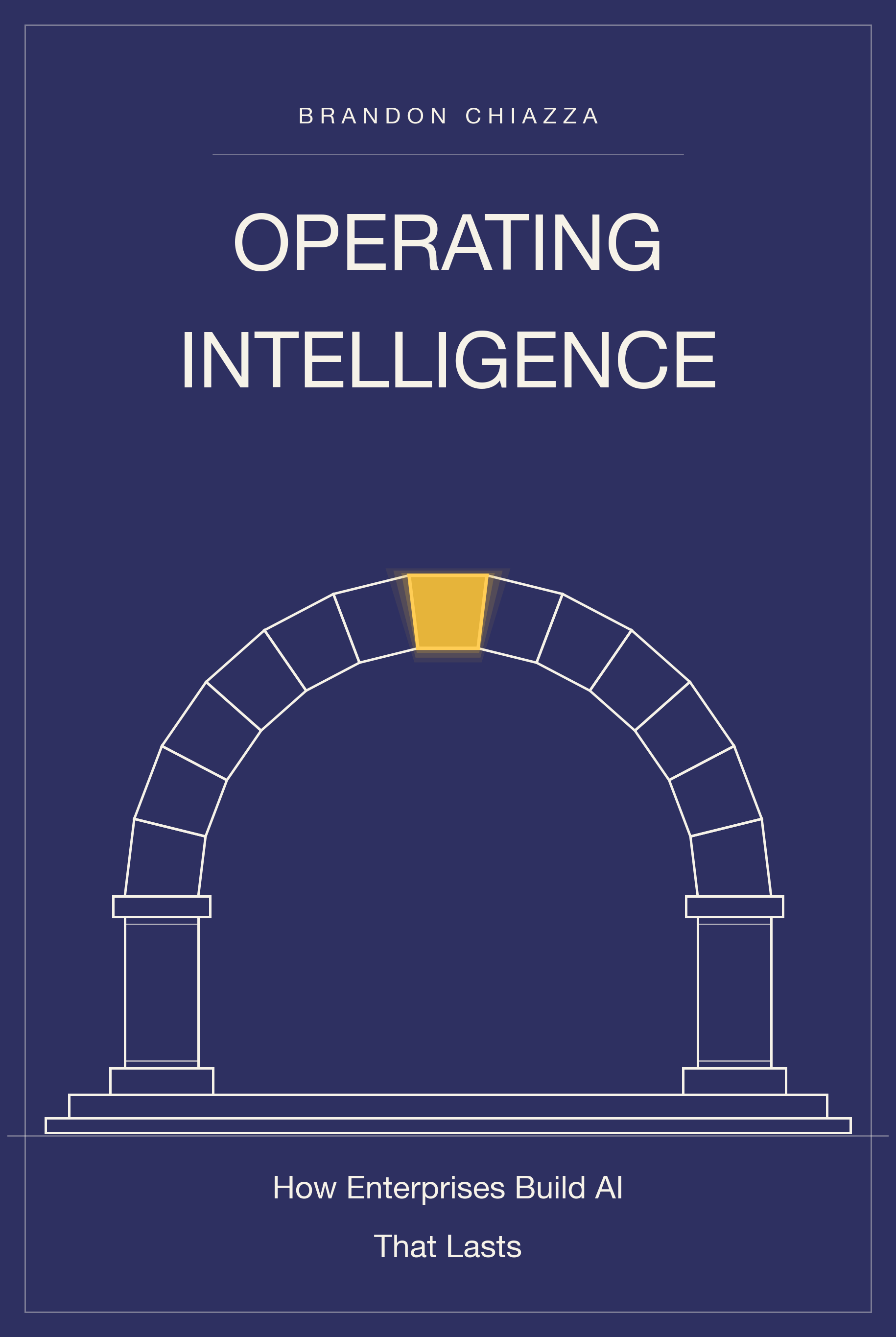
Operating Intelligence

Operating
Intelligence

How Enterprises Build AI That Lasts.

Models are increasingly shared. The competitive ground has moved — to the context layer the organization builds around the model, the proof-of-value discipline that distinguishes capability from value, and the operating-model change required to absorb either.

Operating Intelligence — book cover
"A proof of concept shows that the technology can perform. A proof of value shows that the work improves."

— Law 3

Three editions · One argument

Choose your edition.

Executive Edition

$19.99

paperback · $9.99 Kindle

The strategic spine in ~250 pages. Front matter, the Twelve Laws, Parts I, III, and VI of the full book, plus the Epilogue and Glossary. Built for executives, board members, and governance leaders deciding whether the AI investment is producing value.

Pre-order on Kindle →

Full Edition

$39.99

paperback · $19.99 Kindle

All 650 pages. Strategic foundation, data and governance, system-building (LLMs, prompts, RAG, agents, multi-agent), operating chapters (tooling, security, cost), value, adoption, future. The reference manual for the people who will build, govern, and operate the program.

Pre-order on Kindle →

Reader Edition

Free

with newsletter signup

The full book as a polished PDF designed to read on screen — cover prepended, chapters opening on recto pages. The version reviewers and corporate evaluators get. Available on launch.

Notify me when ready →

Kindle pre-orders open today; ebook ships Summer 2026. Paperback releases on the same day; join the list to be notified the moment paperback is buyable on Amazon.

The framework

The Twelve Laws of Enterprise AI.

The argument of the book, compressed into twelve operating principles. Short enough to quote in a board meeting. Substantive enough to hold the program accountable to them.

  1. 01

    Models are the smallest part of enterprise AI advantage.

  2. 02

    The Context Layer is the durable asset. Everything else depreciates.

  3. 03

    A proof of concept shows the tech can perform. A proof of value shows the work improves.

  4. 04

    Baseline before you build. A weak baseline is more useful than no baseline.

  5. 05

    Hallucinations are a structural property of next-token prediction, not a bug.

  6. 06

    A disclaimer is not a control boundary.

  7. 07

    Bounded autonomy: permissions, reversibility, and escalation are first-class design decisions.

  8. 08

    The evaluation harness is the precondition for everything else.

  9. 09

    Three words for value: projected, realized, banked.

  10. 10

    Every AI system needs a written rule under which it will be taken offline.

  11. 11

    Authority should match accuracy.

  12. 12

    Operating-model change is not the consequence of AI adoption. It is the price.

Working artifacts

Designed to be filled in, marked up, and worked from — not just read.

Three downloads adapted from real engagements.

Self-Assessment

The Twelve Laws Self-Assessment

Twelve questions, one per Law, scored 1–5. Produces a maturity readout in four bands. Use for self-diagnosis, cross-functional comparison, or initiative-specific review.

Download (with newsletter signup) →

Charter

AI Proof-of-Value Framework

The operating contract between a proof-of-value team and the executive sponsor: baseline, value hypothesis, target users, evaluation method, eval owner, adoption criteria, risk controls, scale-or-stop rule. Fillable template plus the two Framework Quality Tests.

Download (with newsletter signup) →

Diagnostic

The Context Layer Diagnostic

Twenty questions across seven sections assessing whether the organization has a named, governed context layer. Maturity readout in four bands; the section minimum matters more than the total.

Download (with newsletter signup) →

Sample chapter

Read a chapter before you buy.

Chapter 6 — Data Governance in the AI Era — opens with the MyCity, MyAI public-sector AI failure: a chatbot that operated for 28 months under official city branding while answering legally consequential questions wrong. The chapter develops the AI Data Trust Model and the structural controls that distinguish "we deployed AI" from "we govern AI."

Read Chapter 6 (free with email) →

The newsletter

Operating Intelligence Field Notes.

One essay every couple of weeks on enterprise AI as it's actually being built, governed, and operated — drawn from Modali engagements, Cornell teaching, and the cases the book develops. No promotional emails between essays.

Subscribers receive the Twelve Laws PDF as a welcome download. Unsubscribe any time.

Brandon Chiazza

Author

Brandon Chiazza.

CEO of Modali Consulting, where his work focuses on helping enterprises adopt AI in ways that compound value rather than capability.

Faculty at the Cornell Brooks School of Public Policy. Formerly Chief Technology Officer at the New York City Mayor's Office of Contract Services, where he led major digital-transformation work in procurement and public-sector technology.

Holds AI-related patents in cost modeling and procurement. Authored the MyCity, MyAI public-policy case study at Cornell — the public-sector AI deployment that frames the governance argument across Chapters 6, 16, and 19 of the book.

LinkedIn · twelvelaws.ai

Speaking · Workshops · Advisory

Bring the work into your organization.

The Twelve Laws Self-Assessment runs as a 90-minute leadership workshop. The Proof-of-Value Framework and the Context Layer Diagnostic anchor longer engagements. Modali Consulting works with enterprises on the operating disciplines this book develops — context-layer architecture, proof-of-value design, AI governance, and the operating-model change that turns AI capability into banked value.